Home » Best Air Purifiers » The Best Air Purifier for Pets: What Actually Works (and What Doesn’t)
Table of Contents
ToggleIf you share your home with a dog or cat, you already know the deal. There’s hair on the couch, dander floating through every shaft of sunlight, and a smell that’s hard to describe to guests but unmistakable the moment they walk in. Most pet owners reach for air freshener or candles and call it good. Those don’t actually clean the air. They just add fragrance to whatever’s already in it.
An air purifier solves a different problem. It pulls the actual particles out of the air: pet dander, hair fibers, dust, and the odor-causing compounds that come with having animals indoors. Not every air purifier does this equally well, though, and if you’ve ever bought a cheap one and felt like nothing changed, the problem usually comes down to filtration quality and airflow, not the concept itself.
Here’s a straightforward breakdown of what matters when you’re shopping for an air purifier as a pet owner, and what separates one that works from one that just runs quietly in the corner.
Pet dander is not the same thing as pet hair. Hair is visible and lands on surfaces. Dander (the microscopic skin flakes that animals shed constantly) stays airborne for hours. It’s lighter than dust and travels farther. In a home with cats especially, dander can be found in rooms where the cat rarely goes, because it hitches a ride on clothing, moves through HVAC systems, and settles so slowly that normal air circulation keeps it suspended.
This is why someone with a cat allergy can have a reaction in a house that has “been cleaned” recently. The surface may be clear. The air is not. According to the American College of Allergy, Asthma & Immunology, cat and dog allergens can remain in a home for months, even after the pet is no longer there.
For an air purifier to actually address pet dander and cat allergies, it needs a True HEPA filter. That’s not a marketing term, it’s a standard. A True HEPA filter captures 99.97% of particles at 0.3 microns in diameter. Pet dander typically runs between 2.5 and 10 microns, well within that range. A filter labeled “HEPA-type” or “HEPA-like” does not meet this standard and will leave a meaningful portion of dander in circulation. The EPA recommends HEPA filtration specifically for removing biological contaminants like pet allergens from indoor air.
An air purifier for pet hair and an air purifier for pet dander require the same thing: True HEPA filtration. But they behave differently in the air, which affects where you place the unit and how often the filter needs attention.
Pet hair is heavier. It doesn’t stay airborne long, which means it ends up on floors, furniture, and your black pants about thirty seconds after you put them on. A purifier won’t catch much of the hair that’s already settled, but it can capture finer strands and fibers before they land, slowing down how fast surfaces accumulate.
Pet dander is where the purifier earns its keep. It stays in the air, it recirculates, and it’s what triggers allergic reactions. The best air purifiers for pet dander run continuously at a moderate speed so they’re always processing the room, rather than cycling on and off.
Here’s the thing about pet households specifically: the air quality changes fast and without warning. A purifier running at a fixed low speed may not keep up right after your dog shakes off or the cat tears through the room. A unit with a built-in air quality sensor closes that gap by responding automatically when particle levels spike, then dialing back when things settle.
True HEPA filtration. Non-negotiable for pet dander and cat allergies. Anything labeled differently is a lower standard, full stop.
Activated carbon for odors. HEPA filters capture particles. They don’t address odors. Pet smell comes from volatile organic compounds (VOCs), ammonia from urine, and similar gases that pass straight through a particle filter. An activated carbon layer handles those. Most households with pets need both, not one or the other.
Coverage appropriate to your room size. Air purifiers are rated by CADR (Clean Air Delivery Rate) and by the square footage they’re designed to handle. A unit rated for 300 square feet will not keep pace in an open-concept 900-square-foot living space. Check the specs against the actual room, not the number on the front of the box.
Auto mode. More useful than most people expect. A purifier with a built-in air quality sensor ramps up when particle levels spike and backs off when the air clears. Without it, you’re either running high all the time (loud, and harder on the filter) or running low and leaving gaps when conditions change quickly.
Auto mode matters because pet households don’t have predictable air quality. The dog comes in from outside. The cat tears across the couch. Someone runs the vacuum. A purifier that senses those changes and responds is doing something a fixed-speed unit simply can’t.
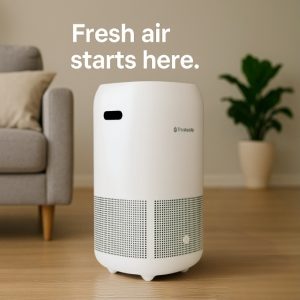
The TrustedAir TruFlow Air Purifier was built around that premise. It uses a real-time air quality sensor to monitor the room continuously, adjusting fan speed automatically as conditions change. The filtration stack includes True HEPA for dander and hair fibers, activated carbon for pet odors, and a washable pre-filter that catches larger debris before it loads up the main filter. The washable pre-filter keeps ongoing maintenance costs down.
Coverage is 800 square feet, enough for most living rooms and great rooms without needing multiple units. At its quietest setting it runs at 22 decibels, quieter than a whisper, so it won’t disrupt a bedroom where a pet sleeps through the night.
For cat households in particular, continuous filtration matters more than most people realize. Fel d 1, the primary protein that triggers cat allergies, is unusually lightweight and sticky. It becomes airborne easily and stays there. Research published in the Journal of Allergy and Clinical Immunology found that Fel d 1 remains detectable in homes and public spaces long after cat exposure ends. A purifier that responds in real time to air quality changes handles that kind of persistent allergen load better than one running at a static speed.
There are air purifiers at every price point, and the cheap ones don’t look that different on the outside.
The differences are in the filter media and the airflow. Budget purifiers often use thinner filter material with lower actual particle capture rates, even when the box says “HEPA.” The motors move less air per hour. And they rarely include both HEPA and activated carbon together.
For someone with mild concerns in a small space, a budget unit might do enough. For a household with cats that trigger genuine allergy symptoms, dogs that shed heavily, or rooms where odor is noticeable to guests, the cheaper units tend to disappoint. You run them for a few weeks, don’t notice much change, and conclude that air purifiers don’t work. Usually the purifier worked fine. The filtration just wasn’t adequate for the load.
Put the unit in the room where your pet spends the most time. If that’s the living room during the day and your bedroom at night, a portable unit you move between rooms will cover more ground than a fixed install in one spot.
Run it continuously, not just when you notice a smell. By the time you’re aware of an odor, the air quality has already been elevated for a while. Continuous operation catches the problem earlier, especially in auto mode.
Vacuum regularly. A purifier handles what’s airborne. Hair and dander that have settled on floors and furniture need to come up through vacuuming. A HEPA vacuum makes a real difference here since regular vacuums without HEPA filtration can re-suspend fine particles while they work.
Stay on top of filter maintenance. Most purifiers signal when it’s time. The TruFlow’s pre-filter is washable, which keeps that step easy, and the main filter typically runs six to twelve months depending on use. A clogged filter pushes the motor harder and cuts into capture efficiency.
The best air purifier for pets combines True HEPA filtration, activated carbon for odors, coverage sized to the actual room, and the ability to respond when air quality changes quickly. Pet households are unpredictable, and a purifier that adjusts automatically handles that reality better than one you have to manage manually.
If you’re dealing with pet dander allergies, cat allergens, or just want a home that smells like a home, a quality HEPA purifier makes a real difference. Match the unit to the room, let it run, and it handles the rest.