Same Day US Shipping

Same Day US Shipping

Air purifiers are one of those purchases where the marketing gets loud and the useful information gets buried. Here's a straight answer on whether they work, a room size chart so you buy the right size, and a plain-English breakdown of every type you'll see on the shelf.
The short answer: yes, for airborne particles, if it's sized for your room. A portable air purifier with a HEPA filter captures airborne particles like dust, pet dander, pollen and smoke as air passes through it. The EPA says filtration can be an effective supplement to removing pollution sources and ventilating, though no air cleaner removes every pollutant.[1]
Whether one works in your room depends on its size, how long and how fast you run it, and what you're trying to clean. The key sizing number is its smoke CADR: too small for the space and it can't keep up.
The honest answer to "do air purifiers work" depends on what you mean by work. Cleaning the air and changing how you feel are two different questions, and the evidence is much stronger for the first.
| Well established Capturing airborne particles | A HEPA purifier sized for the room reduces airborne particles like dust, dander, pollen and smoke. That's what CADR ratings measure.[1][2] |
| Small, mixed Health and symptom improvements | The EPA says studies of portable HEPA air cleaners show health benefits that are typically small and not always noticeable to the person.[1] |
| Small, mixed Allergy and asthma symptoms | Several studies found improvement in one or more symptoms, but not major improvements, and not in every symptom.[1] |
| Depends on the filter Odors and gases | Activated carbon can help, but only with a substantial amount of it. Unlike particles, there's no widely used rating system for gas removal.[1] |
| Not shown Gas removal by UV, plasma or PCO | The EPA says research hasn't yet shown these technologies remove gases effectively in portable home units.[1] |
Put simply: a correctly sized purifier reliably cleans particles out of the air you breathe. Whether you notice a difference depends on what's in your air and how sensitive you are to it. For a closer look at what people tend to get out of one, see the benefits of an air purifier.
For the right person, yes. To decide, add up three costs over a few years, not just the sticker price: the purifier itself, replacement filters, and electricity for running it around the clock.
They tend to be worth it if you: deal with seasonal allergies or pet dander, live where wildfire smoke or city pollution is common, have a household member sensitive to dust or smoke, or cook often in an open-plan home.
They may not be worth it if: your main problem is humidity, mold, or a smell from a specific source you can remove, or you won't run the unit consistently. A purifier that sits switched off doesn't clean anything.
One cost note: with a letter of medical necessity, an air purifier may be eligible for HSA or FSA funds. See HSA/FSA eligibility.
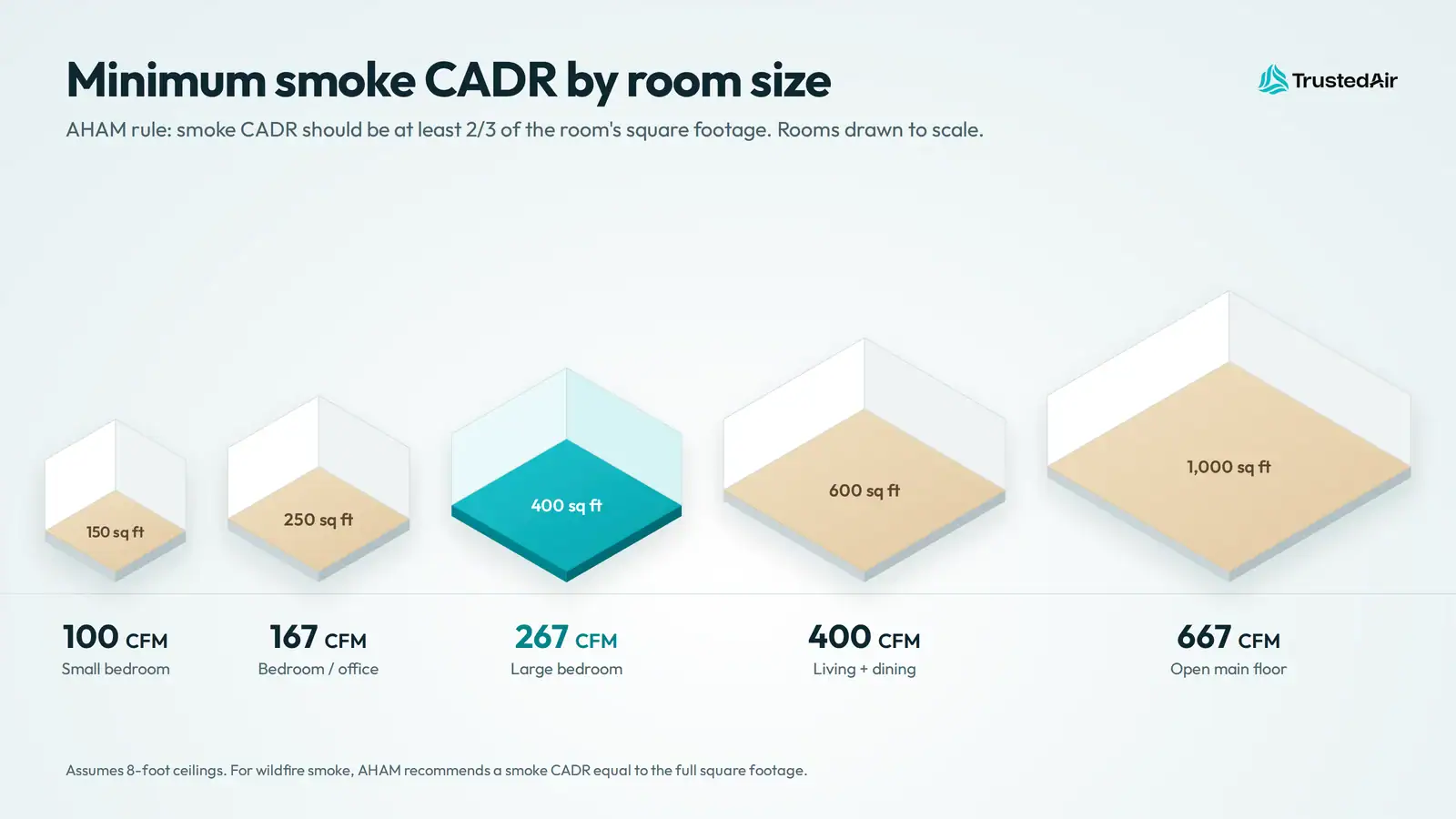
CADR (Clean Air Delivery Rate) measures how much filtered air a purifier delivers, in cubic feet per minute. The industry rule from AHAM, the group that certifies CADR ratings, is simple: your purifier's smoke CADR should be at least two-thirds of your room's square footage.[2] For wildfire smoke, AHAM recommends a smoke CADR equal to the full square footage.[3]
| Room size | Typical room | Minimum smoke CADR | Wildfire smoke CADR |
|---|---|---|---|
| 150 sq ft | Small bedroom, nursery | 100 CFM | 150 CFM |
| 250 sq ft | Primary bedroom, office | 167 CFM | 250 CFM |
| 400 sq ft | Large bedroom, family room | 267 CFM | 400 CFM |
| 600 sq ft | Open living + dining | 400 CFM | 600 CFM |
| 1,000 sq ft | Open-plan main floor | 667 CFM | 1,000 CFM |
Assumes standard 8-foot ceilings. Taller ceilings mean more air to clean, so size up. For large open floors, two units placed apart can spread clean air more evenly than one unit in a corner, as long as their combined CADR fits the space.
Start with the problem, not the product. Each guide below goes deeper on what matters for that situation.
Most of what's sold today is a combination of the technologies below. Here's what each one actually does, and where it falls short.
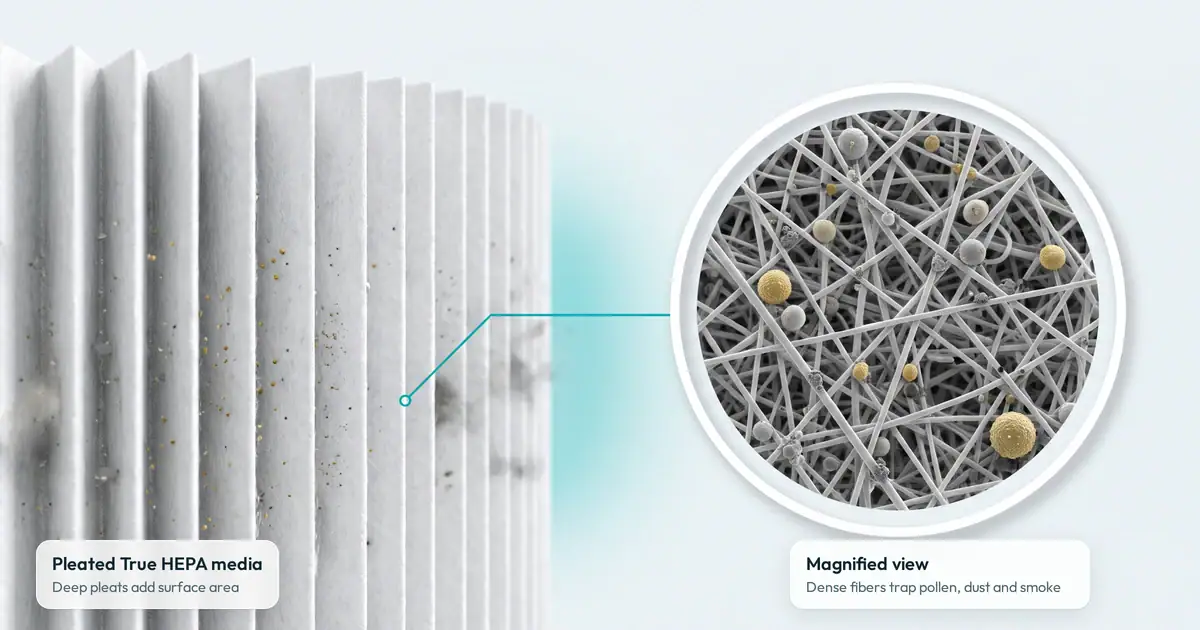
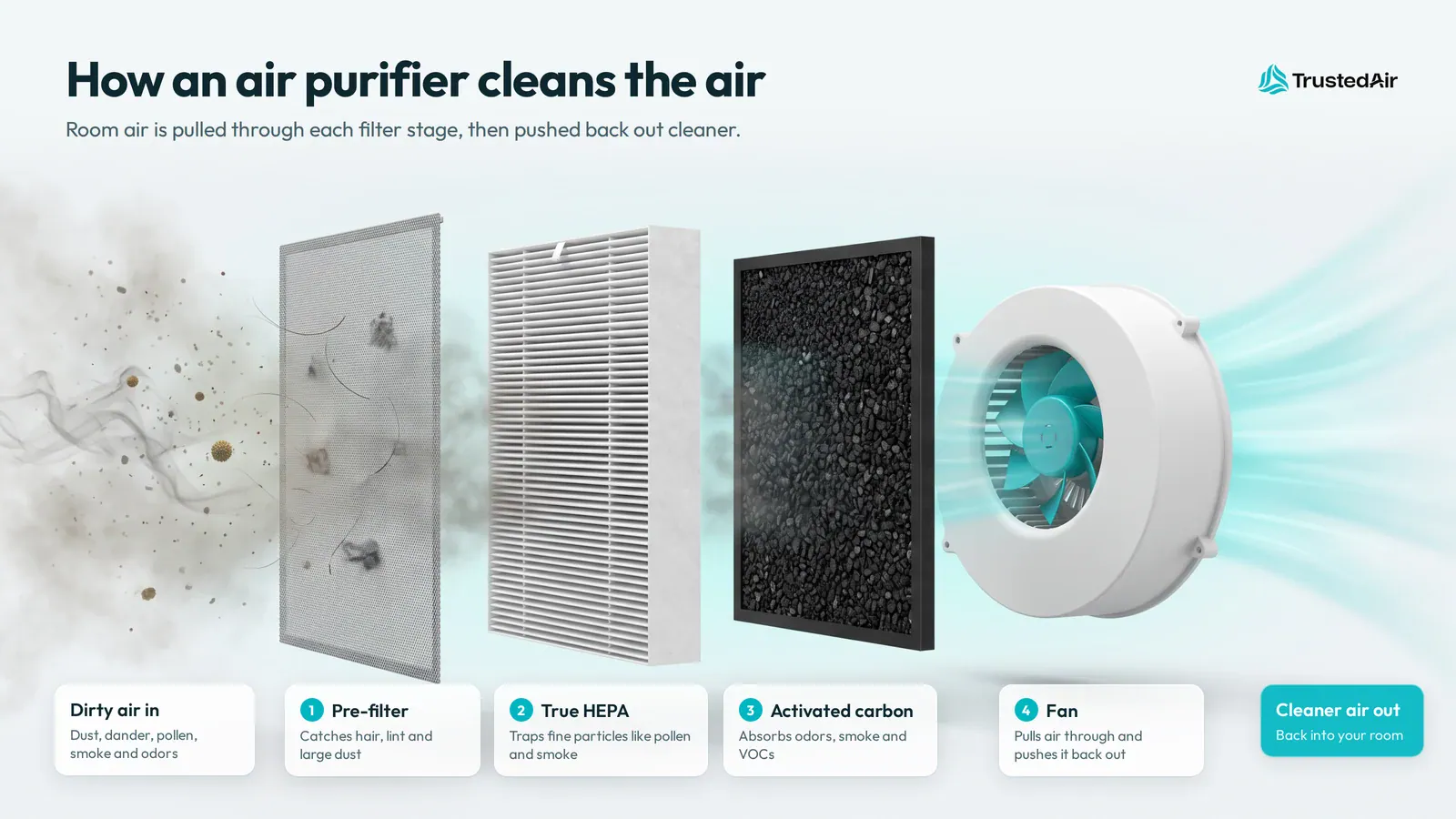
HEPA is a filter efficiency standard (HEPA vs. True HEPA explains the labels): a true HEPA filter captures at least 99.97% of particles 0.3 microns in size in lab testing.[4] That's a measure of the filter media, not of how clean your whole room gets. Room results depend on CADR and room size, which is why the chart above matters.
HEPA does nothing for gases or odors on its own. That's what carbon is for.
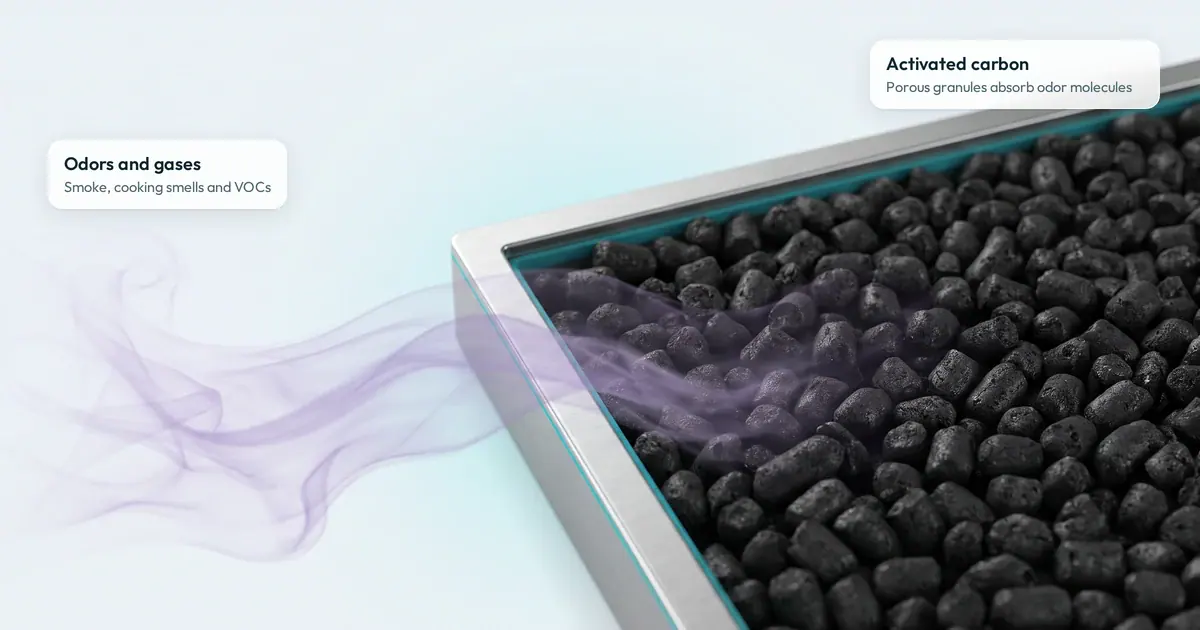
Activated carbon adsorbs odors and some gases, meaning they stick to its porous surface, like cooking smells and VOCs, that pass straight through a particle filter. How well it works depends heavily on how much carbon is in the filter. A thin carbon-dusted sheet does far less than a filter packed with carbon pellets, so look for the carbon weight if a brand lists it.
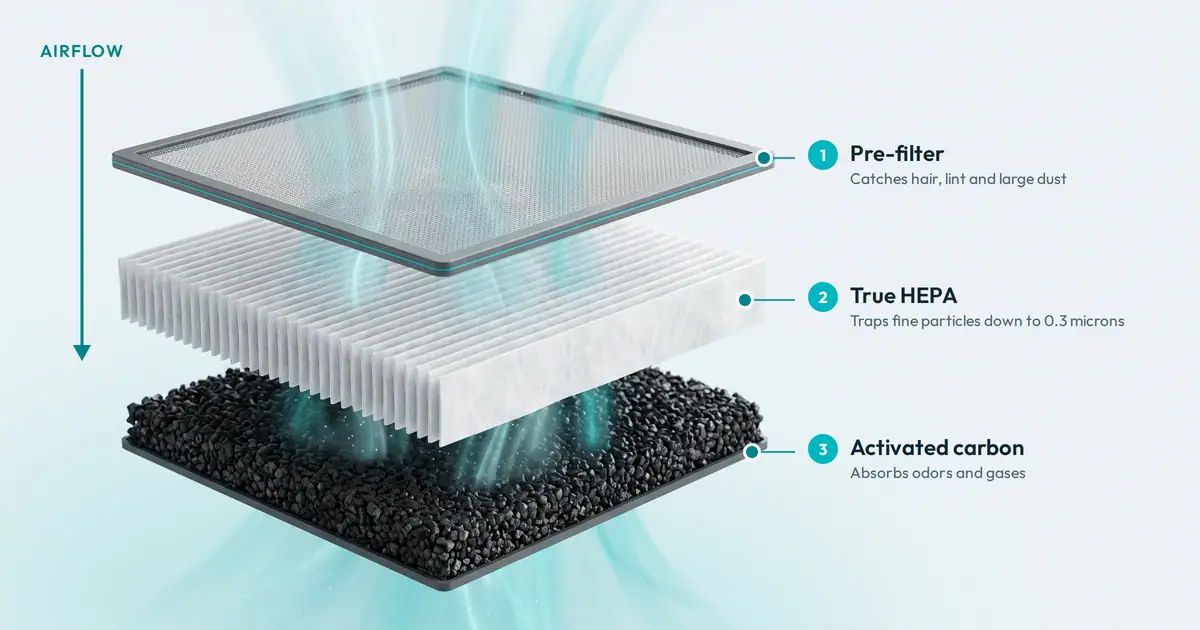
The most common setup, and the right default for most households. A washable pre-filter catches hair and lint, a HEPA layer captures fine particles, and a carbon layer adsorbs odors. If you're unsure what you need, this is it.
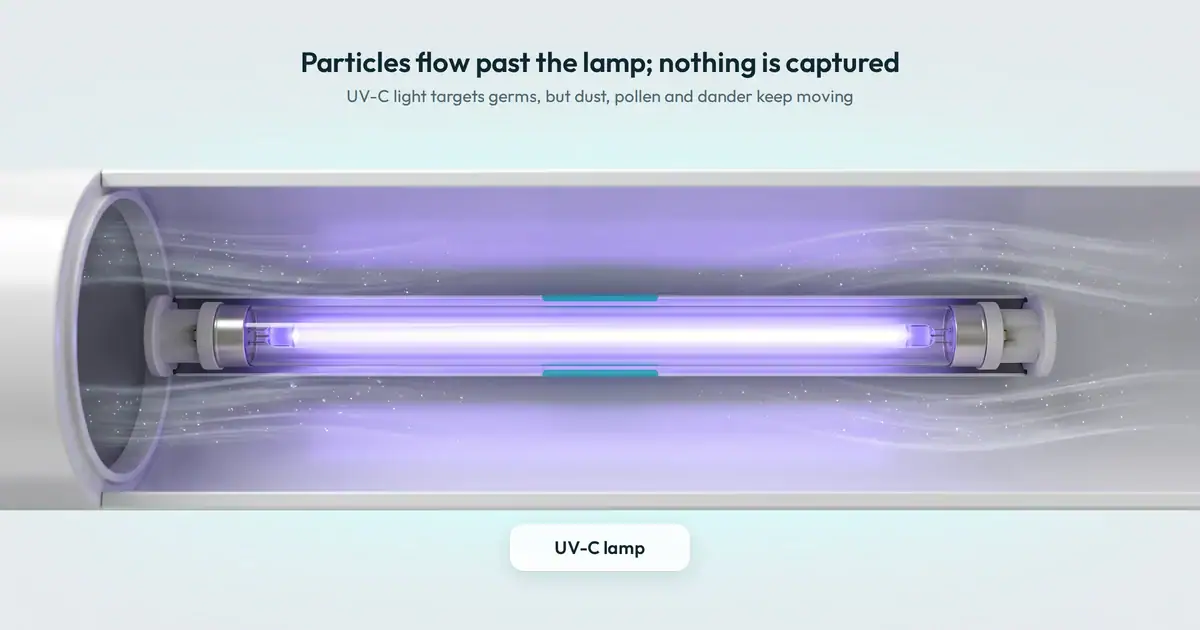
UV-C is usually added inside a purifier to target microorganisms. It doesn't capture particles at all, and air moves past the lamp quickly, so its real-world contribution in a portable unit is hard to judge. The EPA also says research hasn't shown UV can effectively remove gases in portable home air cleaners.[1] How useful it is depends on the design and on whether the brand has published test results, so treat it as a secondary feature, never the reason to buy.
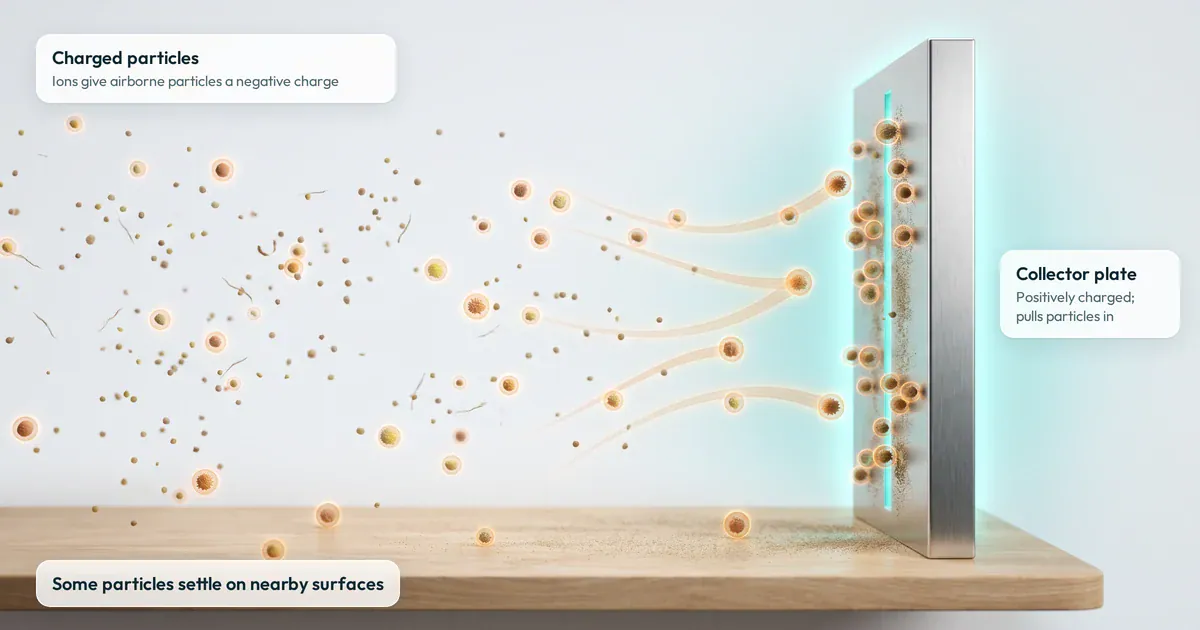
Instead of trapping particles in a filter, these charge them so they stick to a collector plate or settle onto nearby surfaces. Filterless designs can mean lower ongoing costs, but particles that settle on furniture and floors aren't removed from your home. Whatever you buy, confirm it's CARB-certified: California requires certification for any air cleaner sold in the state.[5]
3-stage HEPA and carbon filtration with a 265 CFM smoke CADR, a PM2.5 sensor that adjusts fan speed automatically, and a quiet sleep mode. Coverage is based on CADR at the highest fan speed with 8-foot ceilings.
See the TrustedAir TruFlow
Before you buy any air purifier, check these six things on the box or spec sheet.
For airborne particles, yes, when the unit is sized correctly and running continuously. Health improvements tend to be smaller and vary from person to person, as the research above shows. Most disappointment comes from undersized units or running them only occasionally.
Ongoing filter costs, fan noise at higher speeds, a modest amount of electricity, and floor space. HEPA-only units also do little for odors and gases. See what air purifiers can't do for the full list.
Yes. Indoor air gets re-polluted constantly by cooking, pets, and air coming in from outside. Running continuously, on auto mode if the unit has one, keeps particle levels lower than switching it on only after the air gets bad.
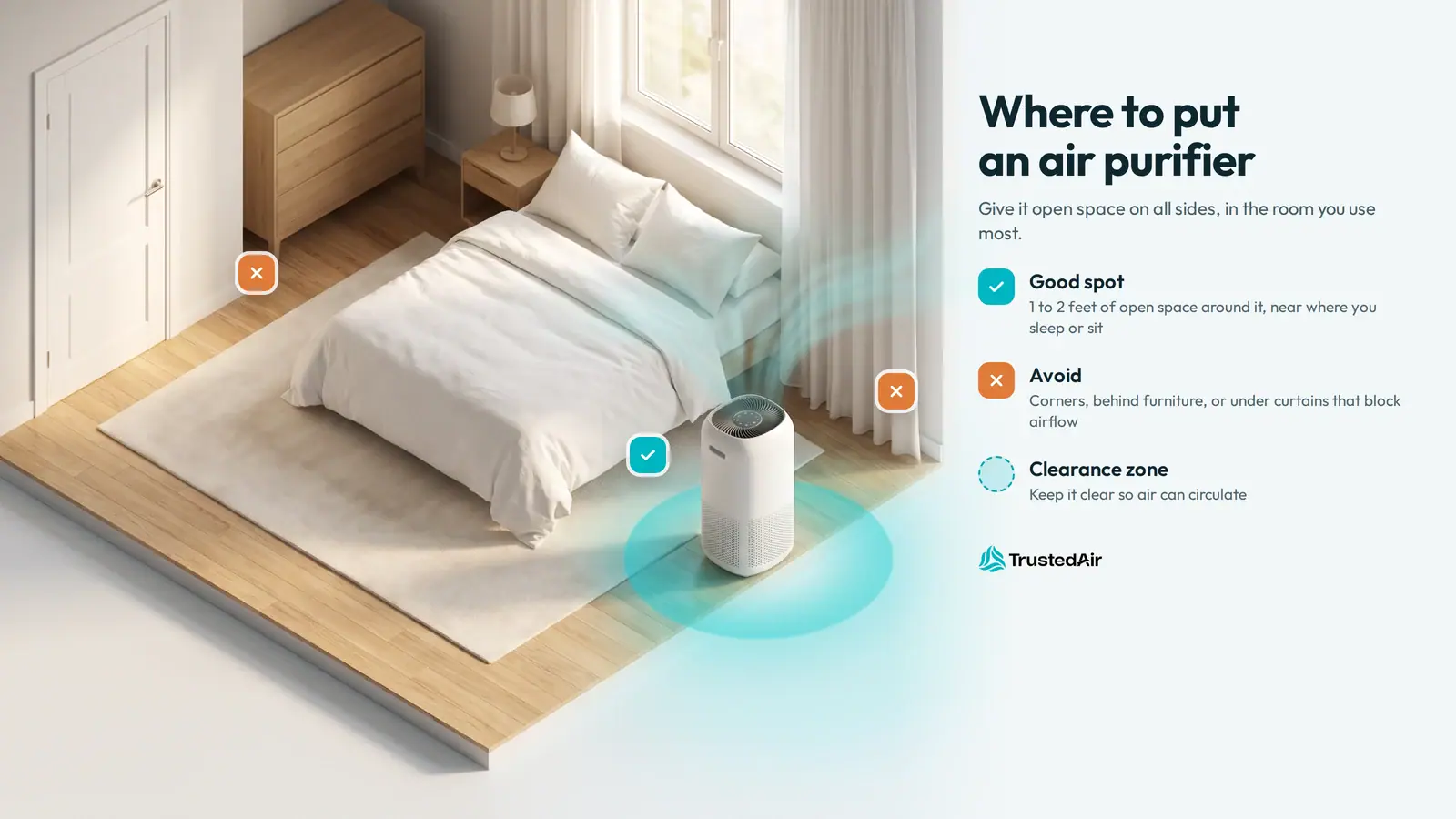
In the room where you spend the most time, usually the bedroom, with a foot or two of clearance on all sides so air can move freely. Our guide on where to place an air purifier covers room-by-room placement.
Multiply your room's square footage by two-thirds to get the minimum smoke CADR. A 300 sq ft room needs at least 200 CFM. For wildfire smoke, match the CADR to the full square footage. Use the calculator above for your exact room.
Do air purifiers work? For capturing airborne particles, yes, as long as the unit is sized for the room and runs continuously. Expect cleaner air reliably and health improvements that are real but often modest. Start with the room size chart, pick a HEPA and carbon unit with enough smoke CADR, and keep it running.
The TrustedAir TruFlow's auto mode reads PM2.5 levels and adjusts its fan speed, with a sleep mode for nights.