Home » Air Purification » Does an Air Purifier Help With Mold? Here’s What Actually Works
Table of Contents
ToggleYou have noticed a musty smell. Maybe you spotted a patch of discoloration in the bathroom or basement. Or perhaps you just want to be proactive, especially if someone in your household has allergies or asthma. Whatever brought you here, the question is the same: does an air purifier help with mold?
The short answer is yes, but with an important caveat. An air purifier can capture airborne mold spores and meaningfully reduce your exposure to them. What it cannot do is eliminate mold that is already growing on a surface. Understanding that distinction is the key to using an air purifier for mold the right way.
Mold is everywhere. Outdoors it plays an important role in breaking down organic matter. Indoors it becomes a problem when it finds the right conditions: moisture, warmth, and a surface to grow on, whether that is drywall, wood, fabric, or grout.The part that directly affects your air quality is the spores. Mold reproduces by releasing microscopic spores into the air, which travel through your home until they land somewhere suitable for new growth or get inhaled by the people living there. Mold spores typically range from 2 to 100 microns in size. For context, a human hair is about 70 microns wide. At the smaller end of that range, spores are completely invisible to the naked eye and can remain suspended in the air for hours. Peer-reviewed research has consistently linked indoor mold and dampness to increased asthma development, respiratory symptoms, and allergic rhinitis across multiple population studies.
Key Fact: Mold spores are airborne particles, which means they are exactly what a quality air purifier is designed to capture. A True HEPA filter removes 99.97% of airborne particles as small as 0.3 microns, well within the range of most mold spores.
Yes, and here is a clear-eyed breakdown of what that actually means in practice.
An air purifier with True HEPA filtration will capture airborne mold spores before you inhale them, reduce the overall spore concentration throughout your home, and help prevent spores from landing and colonizing new surfaces. A unit that also includes an activated carbon layer will go a step further and neutralize the musty odors that mold growth produces, since those odors come from gases that a HEPA filter alone cannot capture. The CDC notes that mold exposure can trigger a range of symptoms in sensitive individuals, from nasal congestion and coughing to severe asthma reactions, which is why reducing airborne spore concentration matters beyond just the smell.
What an air purifier cannot do is kill or remove mold that is already growing on a surface. If you have a visible mold problem, that needs to be physically removed and the moisture source addressed. An air purifier is your defense against what is floating in the air. The mold on your bathroom grout needs a scrub brush, not a filter.
Bottom Line: Will an air purifier help with mold? Yes, it reduces your exposure to airborne spores and the symptoms that come with them. Can an air purifier help with mold? Absolutely, as part of a broader approach that also addresses moisture and any existing visible growth.
Not all air purifiers are equally effective against mold spores. A few features separate the ones that genuinely work from the ones that just look good on a shelf.
This is the single most important feature. A True HEPA filter is certified to capture 99.97% of airborne particles at 0.3 microns, and mold spores fall squarely within that capture range. Be careful about filters labeled “HEPA-type” or “HEPA-style” since these are marketing terms with no certification standard. They do not have to meet the 99.97% capture threshold and in independent testing often perform significantly worse. For mold, you want certified True HEPA.
HEPA filters capture particles, but mold also releases microbial volatile organic compounds, the gases responsible for that distinctive musty smell. A HEPA filter cannot capture gases. An activated carbon layer handles that side of the equation, so if the smell is part of your problem, a purifier that combines both True HEPA and activated carbon is what you are looking for.
A purifier that is undersized for your room will not turn over the air enough to make a real difference. For mold-prone spaces, aim for at least 4 to 5 air changes per hour, meaning the entire volume of air in the room passes through the filter four to five times every hour. Coverage ratings can be misleading since many brands use AHAM’s two-thirds rule, which only guarantees two air changes per hour. Checking the actual CADR rating against your room’s square footage gives you a much more accurate picture than the marketing claim on the box.
Mold spore concentrations change throughout the day. They spike when you disturb a moldy surface, open a window during high outdoor spore counts, or run a humidifier in a poorly ventilated room. A purifier with a real-time PM2.5 sensor and auto mode detects those particle spikes and adjusts fan speed automatically, so the unit works harder when it needs to without you having to think about it.
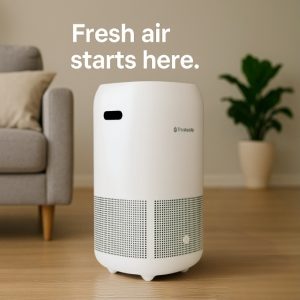
TrustedAir TruFlow Smart HEPA Air Purifier: Combines certified True HEPA with an activated carbon filter, covers up to 1,900 sq ft, and includes real-time PM2.5 monitoring with Auto Mode that adjusts fan speed when air quality drops. CADR rated at approximately 240 cfm for dust, well within the range needed for effective mold spore capture.
Placement matters more than most people expect. For mold concerns specifically, the bedroom is the highest priority since it is where you spend six to eight hours breathing and where cumulative spore exposure has the most impact on your health over time. Basements are another important target because they are naturally humid and prone to mold growth, and spores generated there circulate upstairs through HVAC systems and open doorways faster than most people realize.
For bathrooms, a smaller unit running during and after showers can make a noticeable difference in a space that is poorly ventilated and almost always a mold hotspot. If you have a known mold problem in one area of the home, placing a purifier in the adjacent rooms is a smart move rather than only addressing the source room.
As a general placement tip, keep the unit away from walls and corners. Airflow on all sides maximizes how efficiently it processes the air in the room.
This is one of the most common questions, and the answer is that they solve different parts of the same problem. An air purifier captures mold spores that are already in the air. A dehumidifier removes the moisture that allows mold to grow in the first place. Here is how they compare side by side.
| Air Purifier | Dehumidifier | |
| Captures airborne mold spores | Yes | No |
| Removes musty odors | Yes, with carbon filter | Partially |
| Prevents new mold growth | Partially | Yes (removes moisture) |
| Addresses existing surface mold | No | No — needs remediation |
| Best use | Ongoing spore control | High-humidity spaces |
If your home has high humidity, consistently above 50 to 60 percent, a dehumidifier targets the root cause of mold growth while an air purifier manages the airborne spores that are already circulating. In a mold-prone home, running both gives you the most complete protection. A hygrometer, which costs around ten to fifteen dollars, lets you monitor indoor humidity easily so you know when the dehumidifier actually needs to run.
An air purifier is one piece of the puzzle, and it works best when the rest of the environment supports it. The most important step is fixing the moisture source first. Leaky pipes, poor bathroom ventilation, and condensation on windows are the most common culprits, and no air purifier compensates for an ongoing moisture problem.
Keeping indoor humidity between 30 and 50 percent makes your home inhospitable to mold growth. Running exhaust fans during showers and when cooking, and ensuring basements have adequate ventilation, keeps moisture from accumulating in the spaces where mold thrives most. Your central HVAC filter also deserves attention since a dirty filter becomes a distribution network for spores throughout the house — the EPA specifically flags contaminated HVAC systems as a mold risk to address during any remediation effort, and replacing the filter on schedule is one of the easiest things you can do for whole-home air quality.For any visible mold, the EPA’s guidance for homeowners is that patches under 10 square feet can typically be cleaned by a homeowner using appropriate protective gear and a mold-killing solution. Anything larger than that generally warrants professional remediation. Once the surface mold is addressed and the moisture source fixed, an air purifier handles the ongoing airborne spore load so the problem does not come back as quickly.
An air purifier absolutely helps with mold, specifically by capturing the airborne spores that affect your health and can spread to new areas of your home. For meaningful results, you need True HEPA filtration, adequate coverage for your space, and ideally an activated carbon layer to handle odors alongside particle capture.
It is one part of a complete approach. Fix moisture issues, keep humidity in check, address visible growth directly, and let your air purifier handle what is floating in the air in the meantime. Used consistently, a quality HEPA purifier makes a measurable difference in both spore concentration and the symptoms that come with mold exposure. The WHO’s guidelines on indoor dampness and mould reinforce that reducing airborne exposure through improved ventilation and filtration is a core part of any effective indoor mold management strategy.
The TrustedAir TruFlow Smart HEPA Air Purifier covers up to 1,900 sq ft with certified True HEPA plus activated carbon filtration, real-time PM2.5 monitoring, and Auto Mode that responds to changes in your air quality automatically.
No. An air purifier captures mold spores so they cannot circulate in your air or land and colonize new surfaces. It does not kill mold that is already growing. Some purifiers include UV-C light with claims of killing spores, but evidence for its real-world effectiveness is mixed and depends heavily on how long the spore is exposed to the light. Certified True HEPA filtration is the proven and reliable approach.
In a properly sized room, a quality HEPA air purifier can reduce airborne mold spore concentration significantly within one to three hours. Ongoing improvement continues as the unit runs consistently. Symptom relief such as reduced allergy irritation and less musty odor typically follows within a few days of continuous use, though this varies based on the extent of the mold problem and overall home conditions.
An air purifier can capture Stachybotrys chartarum (black mold) spores that are airborne, the same way it captures any other mold spore. However, black mold is particularly hazardous and any visible growth should be professionally remediated. An air purifier supplements remediation by reducing airborne exposure during and after the process. It is not a replacement for removing the source.
Place the unit in the room where you spend the most time, or in the room most affected by mold-related symptoms. Bedrooms and basements are typically the highest priority. For whole-home coverage, a unit with high CADR and 1,500 or more square feet of coverage placed in a central open area works most efficiently. Keep it away from walls so air can circulate freely on all sides.
Ideally both, since they address different aspects of the problem. A dehumidifier removes the moisture that allows mold to grow. An air purifier captures the spores that are already in the air. If you can only choose one and your home has consistently high humidity, a dehumidifier targets the root cause. If humidity is under control but you are experiencing allergy symptoms or musty odors, an air purifier with True HEPA and activated carbon filtration is the right tool.
Most True HEPA filters are rated for six to twelve months depending on usage and the air quality in your home. In a mold-prone environment, check the filter more frequently since it is working harder to capture spores. A clogged or overloaded filter loses efficiency quickly. Many modern purifiers, including the TrustedAir TruFlow, have a built-in filter replacement indicator that takes the guesswork out of it.