You wipe down the shelves on Saturday. By Wednesday, the same gray film is back. Dust is relentless, and if you have allergies, pets, or an old HVAC system, it is more than an annoyance. So the obvious question is whether an air purifier for dust is worth it, or whether it just hums in the corner while the dust keeps winning.
Here is the short version.
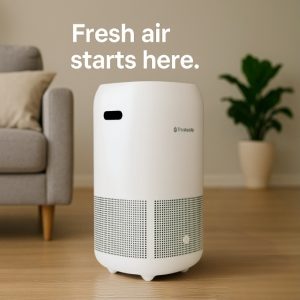
Yes, an air purifier helps with dust. A purifier with a true HEPA filter captures the fine, airborne dust particles that float through your home and land on every surface, which means less dust settling, fewer particles to breathe, and longer gaps between cleanings. It will not stop dust from existing, and it does not replace vacuuming, but it meaningfully lowers how much airborne dust is in the room. You can purchase a TrustedAir Purifier here.
Below, we will break down what dust actually is, how purifiers remove it, exactly what to look for when you buy one, and how to handle specific problems like dust mites, pet hair, and renovation dust.
They do, with one important distinction: airborne dust versus settled dust.
Most household dust is constantly cycling between the air and your surfaces. Every time you walk across a rug, fluff a pillow, or run the AC, particles get kicked back into the air, float around, and settle somewhere new. An air purifier works by pulling that airborne dust through a filter before it has a chance to land. Run it continuously and it intercepts a large share of those particles on each pass, so less of them end up on your coffee table and in your lungs.
What a purifier cannot do is reach the dust already sitting in your carpet, baseboards, and bedding. According to the U.S. EPA, larger allergen-carrying particles tend to settle quickly before a filter can capture them, which is why air cleaning works best alongside regular vacuuming and dusting rather than instead of it (EPA, Guide to Air Cleaners in the Home). Think of a purifier as the tool that handles everything floating in the air, while a vacuum and a damp cloth handle what has already landed. Used together, they keep dust from rebuilding nearly as fast.
Dust is not one thing. It is a mix of dead skin cells, fabric and carpet fibers, pollen, pet dander, soil tracked in from outside, dust mite debris, and assorted microscopic particles. Scientists group airborne particles by size. The EPA refers to coarse particles as PM10 and fine particles as PM2.5, and notes that common indoor pollutants include dust, pollen, and mold spores (EPA).
That size range is the whole challenge. The bigger flecks you can see settle fast and are easy to wipe up. The fine stuff, the particles small enough to stay suspended in the air for hours, is what you actually breathe, and it is the part a good filter is built to catch. It also matters because we spend most of our lives indoors. The EPA estimates people spend about 90% of their time inside, mostly at home, so indoor air is where most of your particle exposure happens. Cleaning that air is not a vanity project. It is where the exposure is.
The engine of any serious dust purifier is a true HEPA filter. HEPA stands for high efficiency particulate air, and the standard is strict. The EPA states that a true HEPA filter can remove at least 99.97% of airborne particles at 0.3 microns, including dust, pollen, and mold, and that particles both larger and smaller than that are trapped at even higher efficiency (EPA, What is a HEPA filter?).
That 0.3 micron figure is the hardest particle size to catch, so a filter rated there is even better at grabbing the rest. Most household dust is far larger than 0.3 microns, which is exactly why HEPA filtration is so effective against it.
A well-designed purifier usually pairs the HEPA filter with a pre-filter. The pre-filter is a coarse first stage that grabs the big stuff, larger dust, lint, hair, and fibers, before it reaches the HEPA media. That protects the more expensive HEPA layer and extends its life. Air gets pulled in by a fan, passes through the pre-filter, then the HEPA filter, and clean air comes out the other side. Repeat that cycle enough times per hour and the airborne dust load in the room drops noticeably.
Not every unit labeled “air purifier” is good at dust, and a few are actively worth avoiding. Here is what actually matters.
True HEPA filtration. This is non-negotiable for dust. Look for “true HEPA” or “HEPA” specifically, not vague phrases like “HEPA type” or “HEPA style,” which can mean a filter that does not meet the real standard. Mechanical HEPA filtration is the proven approach for capturing particles like dust.
CADR matched to your room. CADR, or Clean Air Delivery Rate, tells you how much clean air a unit actually delivers. The American Lung Association recommends a CADR that is at least two-thirds of the room’s cubic feet per minute, and points to HEPA rated units as the most effective type of portable air cleaner (American Lung Association, Air Cleaning). A higher CADR means faster, more frequent dust removal.
Coverage area for your specific space. A purifier rated for a small bedroom will struggle in an open living area. Match the unit’s rated square footage to the room where you will actually use it. Bigger is not always better if it is loud or expensive to run, but undersizing is the most common reason people feel like their purifier “is not doing anything.”
A pre-filter for large dust and hair. If you deal with heavy dust, pet hair, or fibers, a washable pre-filter keeps the HEPA filter from clogging too fast and saves you money on replacements.
No ozone, no ionizers. This one is easy to get wrong. The American Lung Association advises choosing a unit that is certified by the California Air Resources Board (CARB) and that does not rely on ultraviolet, ionizers, or anything that produces ozone, because ozone is a lung irritant (American Lung Association). For dust specifically, you do not need any of that. Straightforward mechanical HEPA filtration does the job without introducing a pollutant of its own.
Smart sensing and auto mode. A built-in particle sensor lets the unit detect dust spikes (say, when you start vacuuming or the dog jumps on the couch) and automatically ramp up fan speed, then ease off once the air is clean again. It means the purifier responds to your home in real time instead of running blind, and you are not stuck guessing which setting to use.
“Dust” looks different in every home. Here is how a purifier performs against the most common variations.
This is where honesty matters. Dust mites themselves live deep in mattresses, bedding, and carpet, and the heavier allergen particles they produce settle quickly, so a purifier cannot vacuum them out of your sheets. The EPA notes that air cleaners are less effective against allergens that fall out of the air fast, which is why dust mite control also requires washing bedding in hot water weekly and vacuuming regularly (EPA). What a HEPA purifier does well is capture the lighter mite allergen particles that do become airborne, especially when you change the bed or disturb the carpet. Use it as one layer of a larger routine, not a standalone fix.
Homes with pets are dust factories: dander, fur, and the extra dust that fur traps and releases. A HEPA purifier with a strong pre-filter is genuinely useful here, capturing airborne dander and the fine dust that pets stir up. It will not pull fur off the floor, so keep vacuuming, but it makes a real difference in how much floats around, which matters a lot if anyone in the home is sensitive to pet allergens.
A purifier can capture airborne mold spores along with dust, which helps. But it does not fix a mold problem. The EPA is direct about this: air cleaners do not address the moisture source that causes mold to grow in the first place (EPA). If you are seeing or smelling mold, find and fix the moisture issue first. A HEPA purifier is a helpful supporting player for airborne spores, not the cure.
Sanding drywall, cutting wood, and demo work throw enormous amounts of fine dust into the air, and it lingers for a long time. A HEPA purifier running during and after the work helps clear that airborne load faster. For active heavy construction, you will still want to seal off the area, wear a proper mask, and clean surfaces, but a purifier shortens how long fine dust hangs in the air once the loud work stops.
The bedroom is the single highest-value place to run a purifier, because you spend roughly a third of your day there breathing that air. A quiet unit with a sleep mode keeps the airborne dust down overnight without keeping you awake. If you only buy one purifier, the bedroom is usually where it earns its keep.
Buying the right unit is half the job. Using it well is the other half.
Run it continuously, or close to it. Dust is constantly being regenerated, so a purifier that runs only an hour a day cannot keep up. Place it in the room where you spend the most time, and keep the doors and windows in that room closed while it runs so it is cleaning your indoor air rather than fighting a constant inflow of new particles. The American Lung Association recommends positioning the unit in the room where the most vulnerable people spend their time, and closing up that room to boost effectiveness (American Lung Association).
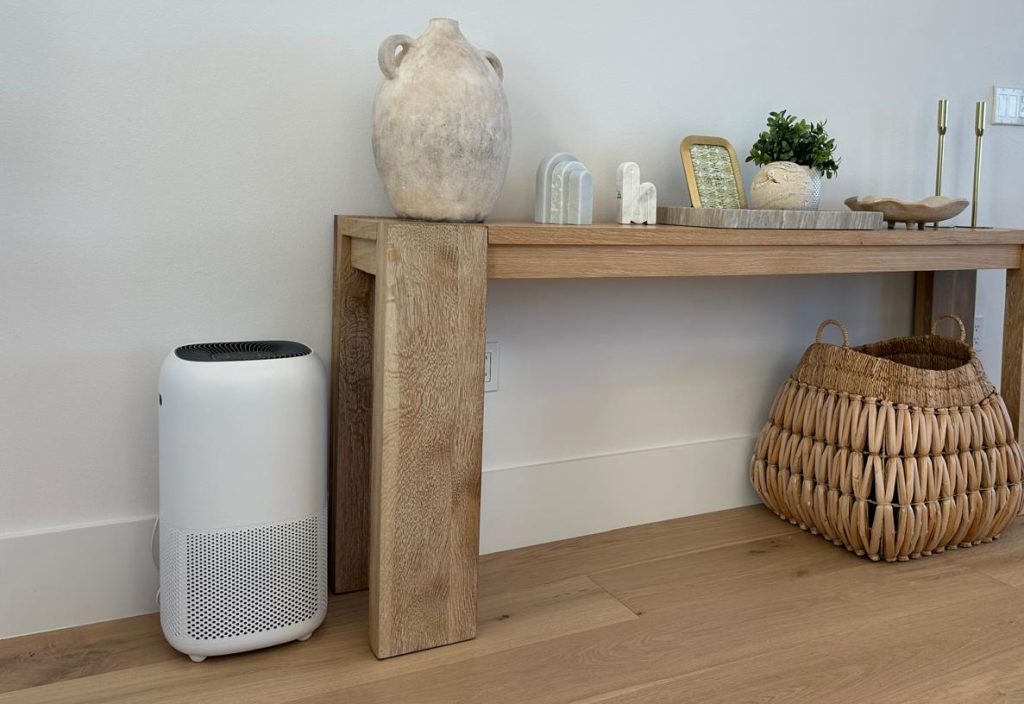
Give the unit some breathing room. Do not jam it against a wall or behind furniture where it cannot pull in air freely. And change the filters on schedule. A clogged HEPA filter cannot capture what it cannot pass air through, so a neglected filter quietly kills performance. A purifier with a filter-life indicator takes the guesswork out of this.
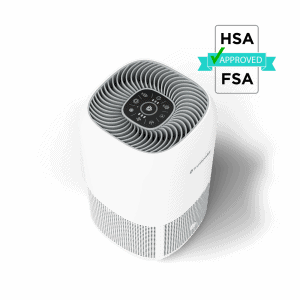
If you want a purifier built specifically around the things that matter for dust, the TrustedAir Purifier was designed to check every box above.
It uses true HEPA filtration to capture fine airborne dust, paired with a pre-filter that handles the larger dust, lint, and hair so the HEPA layer lasts longer. It relies on straightforward mechanical filtration, and it is CARB certified with no ozone, so you get particle capture without introducing a lung irritant of its own. A built-in PM2.5 sensor reads your air in real time and an auto mode ramps the fan up the moment dust spikes, then settles back down once the room is clear, all controllable from the TrustedAir app. It is rated for rooms up to roughly 400 square feet using the AHAM-standard measurement, which covers most bedrooms, living rooms, and home offices.
It is also an HSA and FSA eligible air purifier through our checkout, so for many buyers it can be purchased with pre-tax dollars. The TrustedAir TruFlow Air Purifier is $249. If dust is the problem you are trying to solve, it is built for exactly that.
Do air purifiers really help with dust? Yes. A purifier with a true HEPA filter captures the fine airborne dust that floats through your home before it settles, which reduces how much dust lands on surfaces and how much you breathe. It works best when run continuously and paired with regular cleaning.
Will an air purifier get rid of dust completely? No, and any product that claims it will is overselling. A purifier handles airborne dust, but dust that has already settled into carpet, bedding, and baseboards needs vacuuming and dusting. The two together keep dust dramatically lower than either one alone.
Do air purifiers help with dust mites? Partially. They capture lighter mite allergen particles that become airborne, but the mites and heavier allergens live in bedding and carpet and settle too fast for a filter to catch. Combine a HEPA purifier with weekly hot-water washing of bedding and regular vacuuming for the best results.
Where should I put my air purifier to reduce dust? Put it in the room where you spend the most time, usually the bedroom or main living area, with the doors and windows in that room closed. Keep it clear of walls and furniture so it can pull in air freely.
How long does it take an air purifier to reduce dust? A properly sized unit can noticeably reduce airborne dust within a few hours, and keep it low as long as it runs. Higher CADR and fan speed clear the air faster.
Should an air purifier run all the time? For dust, yes. Because dust is constantly regenerated as you move around your home, continuous operation keeps the airborne load down far better than running it occasionally. An auto mode lets it run quietly and only ramp up when it detects a spike.